 How-to
7 Ways to Test for Hard Water at Home
Last Updated: November 4, 2026
Quick Summary
To test for hard water at home, use test strips dipped in a glass of cold tap water and matched against the package chart, or try a soap test with clear liquid soap in a bottle. Hardness is measured in grains per gallon, and a lab sample gives the most reliable results.
- Hard water is measured as dissolved calcium and magnesium, reported in grains per gallon or mg/L.
- Test strips are fast and inexpensive, but read them exactly at the timing the package specifies.
- A soap test shows only general hardness, with few suds and a film on top.
- Well water should be sent to a certified lab because hardness varies by source.
- Hardness above 7 gpg generally means a softener typically pays for itself.
Table of Contents
- Why Testing for Hard Water Matters Before You Buy Anything
- Water Hardness Test Strips: The Fastest Home Method
- How to Test for Hard Water Without a Kit: The Soap Test
- How to Test for Hard Water in the Shower and at Faucets
- How to Test for Hard Water in a Well
- Reading Your Results: Hardness Units and What They Mean
- Scheduling Your Next Step: When to Call a Water Professional
- Frequently Asked Questions
Hard water leaves a mark you can see and feel. White scale builds up on faucets, cloudy film sits on shower glass, and soap refuses to lather. Before you buy a water softener or a whole-home filtration system, you need to know how hard your water is. AquaShield Home Systems, a family-owned provider of water filtration and plumbing services in Northern Colorado, put together this guide to help you test your water at home.
Water hardness is the amount of dissolved calcium and magnesium in your water. Those minerals come from rock and soil that water passes through on its way to your tap.
Testing gives you a number to work from. That number tells you whether a softener makes sense, what size unit you may need, and whether your problem is hardness or something else. Guessing wastes money on equipment you may not need.
Why Testing for Hard Water Matters Before You Buy Anything
A hardness test is the first step in choosing a treatment system. Without a number, you are guessing at the size and type of equipment you need.
Hardness is not the same as every other water problem. Iron can stain fixtures orange, and sulfur can cause a rotten egg smell. Those problems need different treatment, so it helps to know what you are dealing with first.
Keep these points in mind before you test:
- Hardness shows up as scale, soap scum and spotting, but those signs alone do not give you a measurement.
- Test your cold water at the tap you use most, since that is where you will feel the problem.
- Write down the date and the result so you can compare later, especially after a softener is installed.
Water Hardness Test Strips: The Fastest Home Method
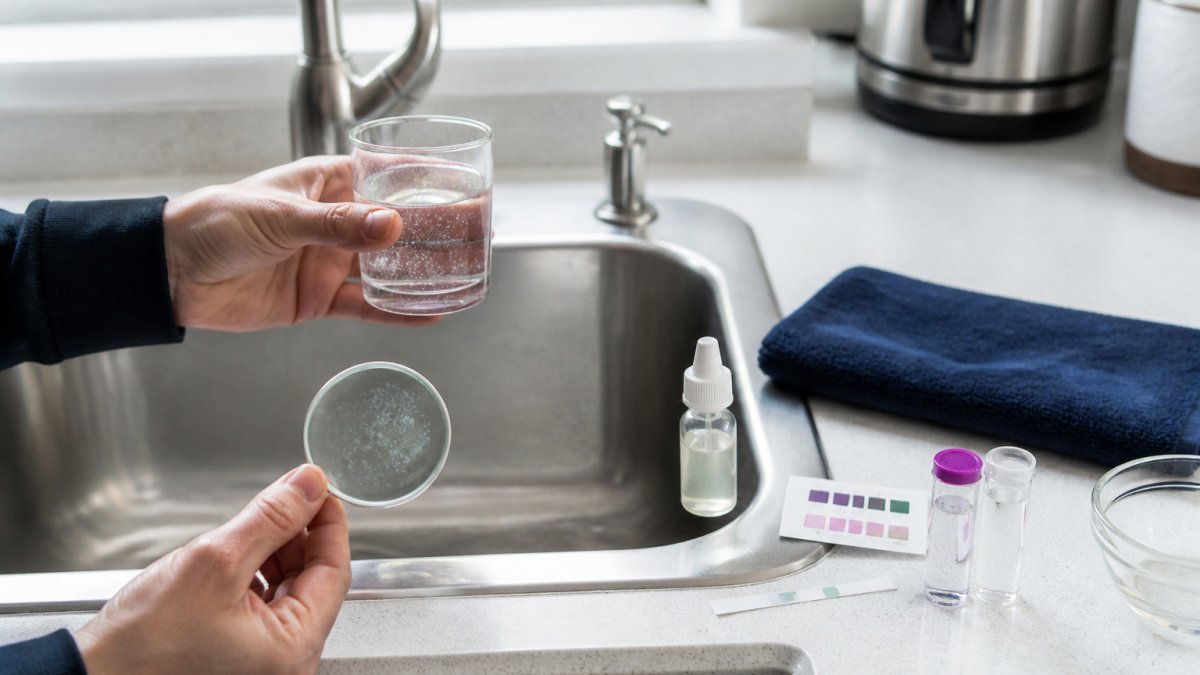
Test strips are one of the quickest ways to check hardness at home. You dip a strip in a glass of cold tap water, wait for the color to change, then match the color to a chart on the package.
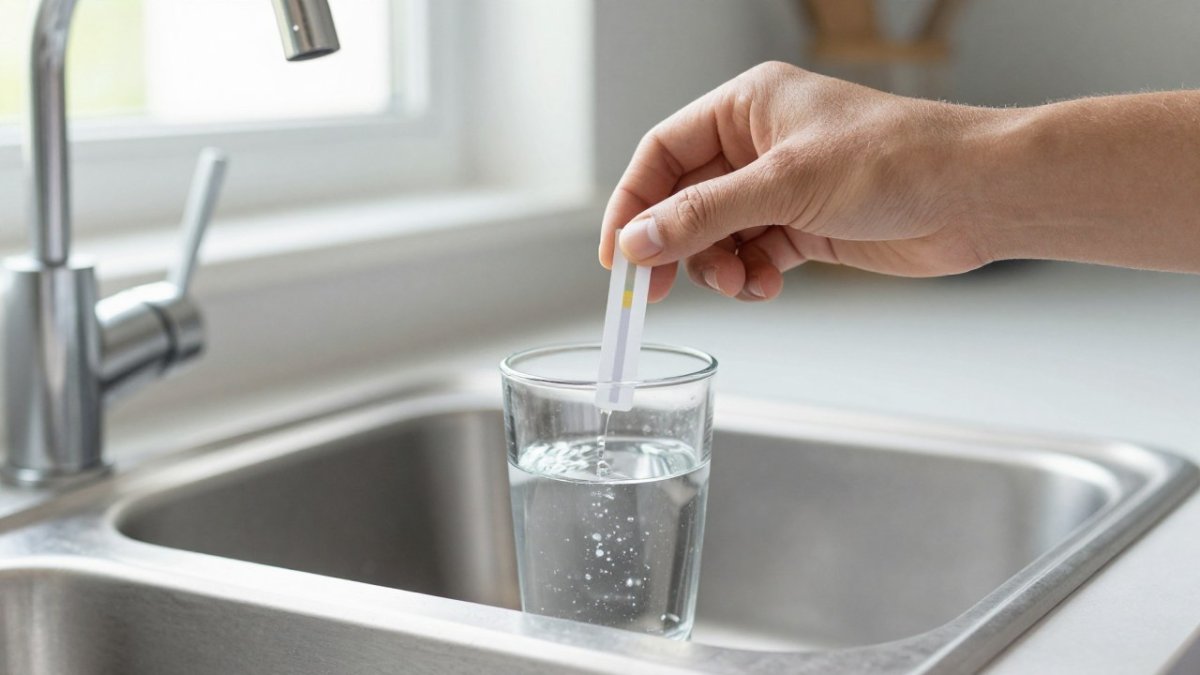
Follow the instructions on the package exactly. Strips vary by brand, and timing matters. Most strips need only a few seconds of dipping and a short wait before you read them. Reading too early or too late is the most common cause of a wrong result.
Strips typically give a range rather than an exact value, so a reading between two steps is normal. If your readings keep disagreeing or your fixtures still show scale, see common softener problems and fixes for troubleshooting ideas. Use strips to decide whether to test further, not as the final word on your water.
Tips for an accurate strip test:
- Use cold water straight from the tap you use for drinking or cooking.
- Let the water run for a minute first to clear the pipes.
- Read the color under good light, not in shadow.
- Check the expiration date, since old strips can give false readings.
- Keep the strip horizontal and do not shake off excess water, which can wash out the reagent.
- Store strips in a sealed container away from humidity and heat.
How strips compare to other methods:
- Soap test: free, but only tells you soft versus hard in general terms.
- Test strips: fast and inexpensive, good for a rough range and for retesting after a softener.
- Titration kit or hardness meter: more precise, resolves hardness to a single number, and is the better choice when you need to size equipment.
- Certified laboratory: the most accurate and the only option that also screens for iron, sulfur, and other contaminants.
Watch out: strips left in a hot garage or bathroom cabinet absorb moisture and drift, so a strip that reads "soft" on water you know is hard is usually a storage problem, not a water problem. If two strips from the same pack disagree, discard the pack and retest with a fresh one.
Buy a fresh pack if you plan to test more than one location, and label each result with the date and the tap you sampled so you can compare later.
How to Test for Hard Water Without a Kit: The Soap Test
You can get a rough idea of hardness using liquid soap and a clear bottle. No special kit is needed.
- Fill a clear plastic bottle about one-third full with tap water.
- Add 10 drops of clear liquid soap. Clear soap works best because you can see the results.
- Cap the bottle and shake it hard for about 10 seconds.
- Set it down and watch for suds.
Soft water produces a lot of suds that last. Hard water produces few suds, and a white film or scum often forms on top.
This test shows hardness in general terms only. It does not give you a measured value. It is useful as a quick check, but use test strips or a lab test if you need a number to make a buying decision.
How to Test for Hard Water in the Shower and at Faucets
Your fixtures often show hardness before any test does. Look at your shower head, faucets and glass shower doors for a white or chalky buildup. Spots that remain after drying are a common sign.
Clean a small section of a fixture with white vinegar and see whether the mark comes off easily. Scale that is hard to remove usually comes from mineral deposits.
Keep in mind that staining can also come from iron, which leaves orange or brown marks. If the stains look rusty, a hardness test alone may not explain them. Test for iron separately before you decide on a treatment.
How to Test for Hard Water in a Well
Well water can differ from city water. Its hardness depends on the rock layers the water passes through, so it can vary from one well to the next, and it can change over time.
Well owners should collect a sample in a clean, sealed container and send it to a certified lab for a full analysis. Lab results can cover hardness along with iron, sulfur and other contaminants that a home kit cannot measure.
A lab test is the most reliable option if your well water has a strong odor, a metallic taste, or staining you cannot explain. Strips and soap tests can miss these other problems entirely.
Reading Your Results: Hardness Units and What They Mean
Hardness is reported in several units, and they are not interchangeable. The most common in the United States is grains per gallon (gpg). Some labs and test kits report parts per million (ppm) or milligrams per liter (mg/L), which are equivalent for practical purposes. One grain per gallon equals about 17.1 mg/L, so a result of 10 gpg is roughly 171 mg/L. Always confirm which unit your test uses before comparing numbers.
The U.S. Geological Survey groups hardness into four ranges that most test kits and softener sizing charts follow:
- Soft: 0-60 mg/L (0-3.5 gpg)
- Moderately hard: 61-120 mg/L (3.5-7 gpg)
- Hard: 121-180 mg/L (7-10.5 gpg)
- Very hard: more than 180 mg/L (more than 10.5 gpg)
Where your number falls points to a different level of treatment. Soft water usually needs no softener. Moderately hard water is a judgment call based on scale and soap use. Hard and very hard water are the ranges where a softener typically pays for itself in reduced scale, soap, and appliance wear.
Interpreting your number:
- A single reading is a snapshot. Hardness can shift with season, rainfall, and the source your utility draws from, so test again in a few months if you are near a range boundary.
- Strips and kits give estimates, and results can differ from one test to the next. If two tests disagree by more than one range step, retest with a titration kit or a lab sample.
- A hardness result does not tell you whether your water is safe to drink. Hardness tests do not detect lead, bacteria, nitrates, arsenic, or other contaminants. Those require separate testing, and a public water report or a certified lab is the right source.
- If you have a softener, sample before and after the unit. Water after a working softener should read at or near the low end of the scale. A reading that stays high usually means the unit is bypassed, out of salt, or due for service.
- Softened water may read differently on some strips because the test is measuring calcium and magnesium, not sodium. That is expected and not a sign of a bad test.
Watch out: comparing a gpg result from a strip to a mg/L result from a lab without converting is the most common interpretation error, 8 gpg and 8 mg/L are not the same water, and the first is hard while the second is soft.
The table below summarises the hardness ranges the article uses, so you can match your own reading to a level and see what it suggests.
| Hardness level | Mg/L | Gpg | What it suggests |
|---|---|---|---|
| Soft | 0-60 | 0-3.5 | Usually no softener needed |
| Moderately hard | 61-120 | 3.5-7 | Judgment call based on scale and soap use |
| Hard | 121-180 | 7-10.5 | Softener typically pays for itself |
| Very hard | More than 180 | More than 10.5 | Softener typically pays for itself |
Scheduling Your Next Step: When to Call a Water Professional
If your results show high hardness, visible scale, or any sign of iron or sulfur, it is time to talk with a professional. A licensed installer can confirm your numbers, recommend the right system size, and explain pricing and installation options.
AquaShield Home Systems offers a no-pressure assessment for Northern Colorado homeowners. Our licensed installers can review your test results, check your water quality, and recommend whole-home water softening, filtration or reverse osmosis options that fit your home. Pricing depends on the system and your home's needs, so contact us for a current quote.
Ready to act on your results? Request a free estimate from AquaShield Home Systems and we will walk you through your options.
Frequently Asked Questions
How can I test my water hardness at home?
The simplest options are test strips, a liquid hardness test kit, or the soap test. Test strips are available at many hardware and home improvement stores and give a color-coded reading in a few minutes. Liquid kits use a drop-count method and tend to be more precise. A basic soap test needs only a clear bottle, a cap and liquid soap, and it gives a rough sense of hardness. For a more exact number, collect a sample and send it to a certified laboratory.
Can you use Dawn to test for hard water?
Yes, you can use Dawn dish soap for a rough check. Fill a clear bottle one-third with tap water, add a few drops of liquid soap, cap it and shake vigorously for about 10 seconds. If the water produces few suds and a cloudy film forms quickly, hardness is likely present. Soft water lathers easily with little effort. This method is a screening tool only and cannot give an exact hardness reading.
Do water filters remove hardness?
Most standard carbon or sediment filters do not remove hardness minerals such as calcium and magnesium. Reverse osmosis systems do reduce hardness, and ion-exchange water softeners are designed specifically for it. Because filter types differ, test your water first so you know which problem you are solving before choosing equipment.
When should I get my water professionally tested for hardness?
Consider professional testing if home test results are inconsistent, if you have a private well, or if you need precise numbers to size a water softener. A laboratory report also helps when you notice other issues such as odor, discoloration or staining. Ask the lab for hardness reported in grains per gallon or milligrams per liter so you can compare it with your softener's rating.