 ultimate-guide
Whole Home Water Filter Installation Cost: 2026 Guide
Table of Contents
- What Drives Whole Home Water Filter Installation Cost
- Signs You Need a Whole Home Water Filter
- Types of Systems and How They Affect Your Quote
- DIY vs Professional Water Filter Installation
- Hidden Costs: Permits, Plumbing Retrofits, and Site Conditions
- Whole House Water Filter Maintenance Schedule and Long-Term Costs
- Frequently Asked Questions
Last Updated: September 21, 2026
What Drives Whole Home Water Filter Installation Cost
Whole home water filter installation cost is not a single number. It is the sum of equipment, labor, site conditions, and the plumbing work your house actually needs. At AquaShield Home Systems, we quote these projects every week, and the honest answer is that two identical-looking homes on the same street can land in different brackets once you open the mechanical room.
Labor vs. Equipment: Where Your Money Goes
Equipment is the predictable half. A sediment filter, a carbon block stage, a pressure regulator, a bypass valve, and the housing that holds them are all standard parts, and their cost scales with system capacity and contaminant removal goals. A point-of-entry system built to handle iron and sulfur in well water carries more filtration media than a basic chlorine-reduction unit.
Signs You Need a Whole Home Water Filter
The clearest signs are the ones you can see and smell. White scale crusting on faucets and showerheads points to water hardness. A rotten egg odor from hot water usually means sulfur. Cloudy water after heavy rain, or a metallic taste in coffee and tea, points to sediment or dissolved metals getting past your municipal supply.
Types of Systems and How They Affect Your Quote
The system type you choose is the single biggest lever on your total project cost. Here is how the common categories compare.
Sediment and Carbon Block Filters
Sediment filters are the first line of defense. They trap sand, rust, and grit before anything else in the system sees it, which protects downstream filtration media from clogging early. A carbon block stage follows and handles chlorine reduction, taste, and odor.
Reverse osmosis and Point-of-Entry Systems
Reverse osmosis is a different job. A whole-home RO system pushes water through a membrane under pressure, which means it needs a drain line, a storage tank or a booster pump, and enough water pressure to work properly. Point-of-entry systems sit at the main water line and treat everything entering the house.
| System Type | Typical Plumbing Work | Best For | Maintenance Load |
|---|---|---|---|
| Sediment + carbon block | Bypass valve, short pipe run | Municipal water, taste and odor | Cartridge swaps |
| Point-of-entry | Main line tie-in, drain access | Whole-home treatment | Media replacement |
| Whole-home reverse osmosis | Booster pump, drain line, storage | Heavy contaminant removal | Membrane and filters |
DIY vs Professional Water Filter Installation
Professional installation is the right call for anything tied into the main water line. That is the short answer, and it is not a sales pitch. Once you cut into the line that feeds every fixture in the house, a mistake does not just leak. It can flood a basement, void a manufacturer's warranty, and create a cross-connection that puts your drinking water at risk.
What a Licensed Installer Actually Brings
- Permits. Many jurisdictions require a plumbing permit for any work on the main water line, and the permit triggers an inspection. A licensed plumber knows which office to file with, what the inspection covers, and how to schedule it so the job does not stall.
- Code compliance. Plumbing code governs backflow prevention, drain connections, pipe materials, and how a point-of-entry system ties into the main line. A backflow preventer is not optional in most code cycles, and getting it wrong can contaminate the household supply.
- Insurance. If a licensed installer floods your basement, their liability coverage responds. If you flood your own basement, your homeowner's policy may or may not cover a DIY plumbing failure, depending on the policy language.
- Warranty protection. Most manufacturers require installation by a licensed professional to honor the equipment warranty. A DIY install can void coverage on the very components most likely to fail.
- Resale documentation. A permitted, inspected install produces a paper trail. An unpermitted one can surface during a home inspection and become a negotiation problem at closing.
Where DIY Actually Makes Sense
DIY is reasonable for the maintenance side of ownership, not the installation side. Swapping a sediment cartridge, replacing a carbon block, or changing an RO membrane is homeowner-level work if you shut off the bypass valve first. Those tasks do not touch the main line and do not require a permit.
DIY installation risks cluster in a few predictable places:
- Sizing the system for your actual flow rate in GPM, not the number on the box
- Setting the pressure regulator so the system is not starved or over-pressurized
- Installing a bypass valve correctly so you can service the unit without shutting off the house
- Matching pipe diameter so you do not choke flow to the second floor
- Transitioning between copper and PEX without creating a dielectric or corrosion problem
The Middle Path: Pro Install, Owner Maintenance
The most cost-effective arrangement for most households is a licensed install followed by owner-performed filter changes. You pay for the permit and the main-line tie-in once, then keep the recurring cost down by handling cartridges yourself. Ask your installer to walk you through the bypass valve and shut-off sequence before they leave, and keep the permit and inspection paperwork with your home records.
Hidden Costs: Permits, Plumbing Retrofits, and Site Conditions
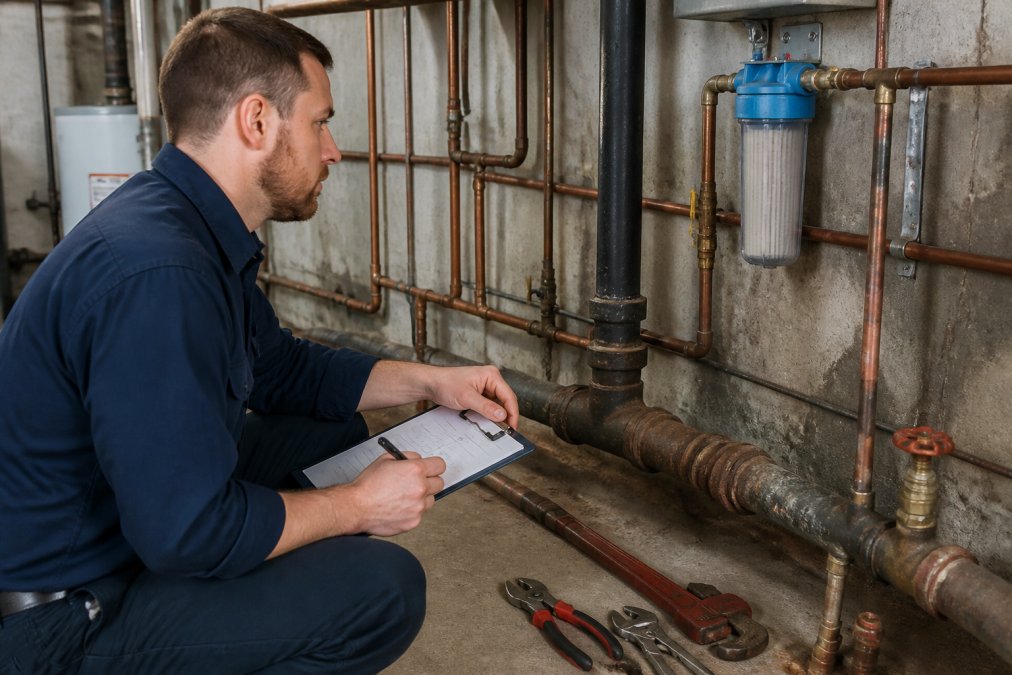
Hidden infrastructure costs show up in three places:
- Pipe material. Copper piping and PEX tubing are both fine, but transitioning between them, or replacing a corroded section, adds labor.
- Access. A main line in an unfinished basement is easy. One buried behind a finished ceiling is not.
- Water pressure. If incoming pressure is too high, you need a pressure regulator. Too low, and an RO system needs a booster pump.
Whole House Water Filter Maintenance Schedule and Long-Term Costs
A Practical Maintenance Schedule
- Every 1-3 months: inspect for leaks, check pressure gauge readings, log any pressure drop
- Every 6-12 months: replace sediment and carbon block cartridges
- Every 1-3 years: replace filtration media in point-of-entry systems
- Every 2-3 years: replace reverse osmosis membranes
- Annually: retest water quality to confirm performance
How to Build a Five-Year TCO Estimate
You do not need a spreadsheet to get a realistic picture. You need four inputs, and any honest provider can supply all four before you sign.
- Equipment and installation. The one-time figure on the quote, including permits and any plumbing retrofit.
- Consumables per year. Cartridges, media, and membranes, multiplied by how often your water quality and usage actually require replacement.
- Service calls. If you want a technician to handle changes, add a per-visit labor charge. If you handle them yourself, this line drops to zero.
- Water testing. Annual lab testing to confirm the system is still performing. This is the line most owners forget, and it is the one that catches a failing membrane before it affects water quality.
What Actually Drives the Recurring Cost
Two variables dominate. How hard your water is, and how much water your household uses. A family of five on hard well water will burn through cartridges faster than a couple on treated municipal water. Iron and sulfur in well water shorten media life further, and sediment-heavy supplies can clog a pre-filter in weeks rather than months.
Post-Installation Water Testing: The Step That Confirms You Got What You Paid For
Test before and after installation, and keep both reports. The before test establishes a baseline for what was in the water. The after test confirms the system is removing what it was specified to remove. If the after test shows a gap, you want to know while the installer is still on the hook for the fix, not two years later when a membrane fails.
Frequently Asked Questions
Is it worth getting a whole house water filter?
It depends on your water quality and goals. If you see scale buildup on appliances, notice chlorine taste, or deal with sediment, a whole home system can reduce those issues across every tap. The value comes from protecting plumbing and appliances while improving drinking water. A water quality report and a professional assessment help you decide if the investment fits your home.
What are the disadvantages of a whole house water filter?
The main drawbacks are upfront cost, ongoing filter replacements, and the space required for installation. Some systems reduce water pressure if sized incorrectly. You also need to commit to a maintenance schedule to keep the system working well. Professional installation and proper sizing minimize these issues, but they do not disappear entirely.
Can I install a whole house water filter myself?
You can, but DIY installation carries real risks. Cutting into the main water line, soldering copper piping, and handling pressure regulators require plumbing skill. Mistakes can cause leaks, code violations, or voided warranties. If you are not comfortable with plumbing retrofitting, hiring a licensed installer is safer and often cheaper long-term.
How often do whole house water filters need to be replaced?
Most sediment filters need replacement every 3 to 6 months. Carbon block filters typically last 6 to 12 months. Reverse osmosis membranes can last 2 to 3 years with proper pre-filtration. Your exact schedule depends on water hardness, sediment levels, and system capacity. A maintenance plan keeps replacements on track.
What factors influence the total installation cost?
Labor rates, site complexity, pipe diameter, and whether plumbing retrofitting is needed all affect the total. Water pressure, existing shut-off valves, and the type of system you choose also play a role. Hidden costs like permits and post-installation water testing can add to the project. A professional assessment gives you the most accurate picture.