 ultimate-guide
Whole Home Water Filtration System Maintenance Guide
Table of Contents
- Why Whole Home Water Filtration System Maintenance Matters
- Your Whole-House Water Filter Replacement Schedule
- How to Change Whole-House Water Filter Cartridges Safely
- Water Softener Maintenance: Salt, Brine, and Resin Care
- Reverse Osmosis Filter Replacement and Sanitizing
- Troubleshooting Reduced Water Pressure and Other Symptoms
- A Complete Maintenance Calendar by System Type
- Planning Maintenance Costs and Replacement Parts
- Frequently Asked Questions
Last Updated: October 18, 2026
Why Whole Home Water Filtration System Maintenance Matters
We see the same pattern across Northern Colorado: a homeowner invests in a whole-house water filter, enjoys great water for a year, then forgets the housings exist until shower pressure drops.
That's the throughline of this guide: maintenance isn't an upsell, it's the difference between a water filtration system that lasts a decade and one that becomes a plumbing problem.
Your Whole-House Water Filter Replacement Schedule
There is no universal interval. Your schedule depends on your source water, household size, and each cartridge's micron rating and media type. Treat manufacturer intervals as a baseline and adjust based on what you actually observe.
A practical starting framework looks like this:
| Component | Typical Baseline | What Shortens It |
|---|---|---|
| Sediment pre-filter | 3-6 months | Well water, sediment buildup, high household use |
| Carbon block or GAC | 6-12 months | High chlorine, taste and odor complaints |
| Softener resin | 10+ years, with care | Iron, chlorine exposure, poor brine upkeep |
| RO pre- and post-filters | 6-12 months | Heavy sediment, low source-water quality |
| RO membrane | 2-3 years | Fouling from skipped pre-filters |
Sediment and Carbon Filter Intervals
Sediment filters are the workhorses. They trap sand, rust, and grit before anything downstream sees it, protecting the carbon stage and every fixture.
Carbon filters handle taste, odor, and chlorine. The tell is usually sensory: water tastes flat, or the chlorine smell returns. On well water with sulfur, carbon helps with the rotten-egg smell but isn't a fix on its own.
How Water Quality and Household Use Change the Timeline
Two homes on the same street can need different schedules. A family of five on a well with visible sediment will burn through sediment cartridges far faster than a retired couple on municipal water. Iron and sulfur accelerate loading, and high water use pushes more volume through every stage. Inspect cartridges at the interval and let what you see set the next one.
How to Change Whole-House Water Filter Cartridges Safely
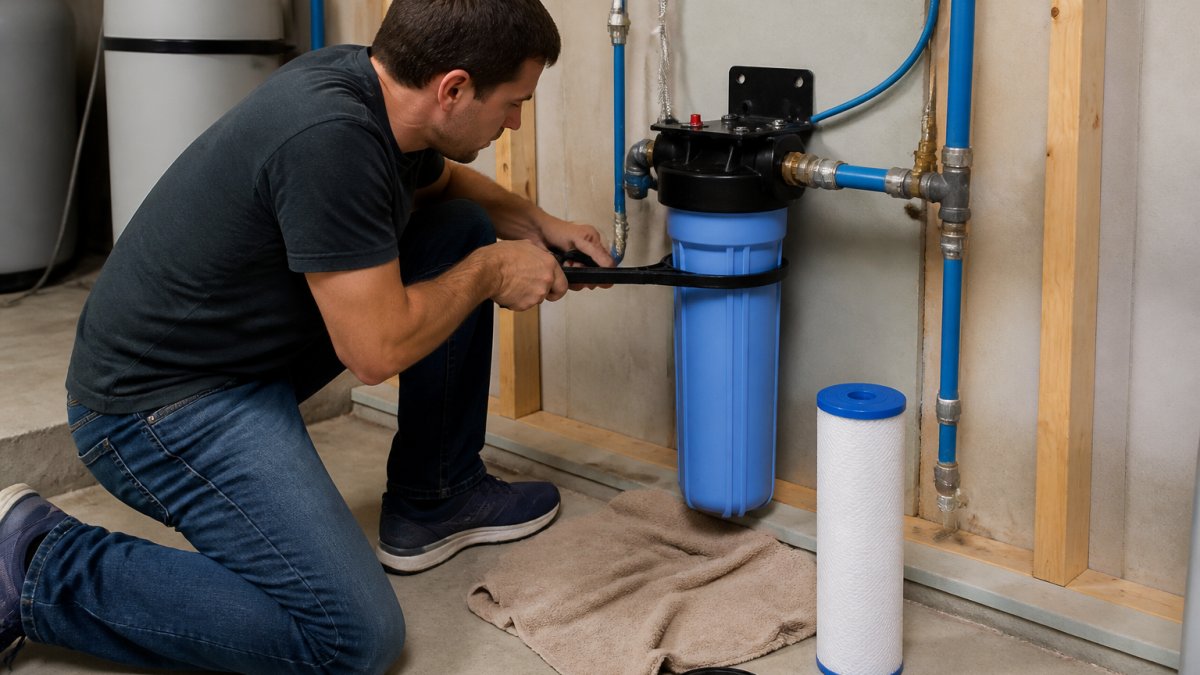
Changing cartridges is a homeowner-level job if you follow the sequence. The two mistakes that flood utility rooms are skipping the shutoff and failing to release pressure before opening a housing. Do it in this order:
- Shut off the water supply to the system at the valve before the filter.
- Open a downstream faucet to relieve pressure, then press the housing's pressure-release button if it has one.
- Use a filter wrench to loosen the sump slowly. Expect a little residual water; keep a towel and shallow bucket underneath.
- Remove the old cartridge, dump standing water, and wipe the housing interior.
- Inspect the O-ring for cracks or grit, lubricate it with a food-grade silicone lubricant if the manufacturer calls for it, and reseat it.
- Install the new cartridge with the flow arrow or label matching the housing direction.
- Hand-tighten the sump, then snug with the wrench, never overtighten.
- Open the supply slowly and check for leaks, then flush the line per the manufacturer's instructions before drinking.
Water Softener Maintenance: Salt, Brine, and Resin Care
Water softener maintenance is mostly about salt and the brine tank. Check the salt level monthly and keep it above the water line, but don't overfill, a bridged or crusted salt bed stops dissolving and the softener silently stops softening.
Resin care matters too. Iron and chlorine degrade resin, and a fouled bed loses capacity. Watch for hard water returning, soap that won't lather, or salt running out faster than usual, signs the system needs service, not just more salt.
Reverse Osmosis Filter Replacement and Sanitizing
Reverse osmosis filter replacement follows the same logic as whole-house stages, but the stakes are higher for the membrane. The sediment and carbon pre-filters protect it; skip them and the membrane fouls, the expensive part.
Sanitizing the storage tank and lines is the step most homeowners skip. Follow the manufacturer's procedure, typically a chlorine solution, contact time, and thorough flush.
Troubleshooting Reduced Water Pressure and Other Symptoms
Reduced pressure is the classic sign of a clogged filter, but not the only one. Before assuming the filter, check for a partially closed valve, a tripped pressure switch, or a well pump issue on a private system. On city water, a whole-house pressure drop points toward the filter or a line restriction.
Other symptoms worth noting:
- Rotten-egg smell returning: carbon is exhausted, or sulfur needs dedicated treatment.
- Cloudy or gritty water: sediment cartridge is bypassing or overdue.
- Softener not keeping up: salt bridge, low salt, or fouled resin.
A Complete Maintenance Calendar by System Type
A calendar keeps maintenance from becoming an emergency, but a generic monthly/quarterly/annual grid hides the differences that matter most. UV lamps, catalytic carbon, iron-removal media, and backwashing filters each follow their own rhythm; treating them like a sediment cartridge leaves a system that runs but no longer treats. Use the framework below as a starting point, then adjust to your water test results and household.
| System Type | Monthly | Quarterly | Annually |
|---|---|---|---|
| Whole-house sediment/carbon | Check pressure and flow | Inspect or replace sediment | Replace carbon, inspect O-rings |
| Water softener | Check salt level | Check for bridging | Service resin, clean brine tank |
| Reverse osmosis | Check production and taste | Inspect pre-filter | Replace pre/post filters, sanitize |
| UV disinfection | Confirm lamp is lit | Wipe quartz sleeve | Replace lamp, inspect sleeve for fouling |
| Catalytic carbon | Check for taste/odor breakthrough | Backwash per manufacturer | Replace media per bed-life guidance |
| Iron removal (air or chemical) | Check oxidizer and pressure | Test treated iron | Service injector, inspect media bed |
| Backwashing media filter | Confirm backwash cycle runs | Inspect control valve | Deep clean or rebed as needed |
| Well water systems | Check wellhead and pump | Test water quality | Full inspection and contaminant testing |
Technology-Specific Upkeep the Generic Calendar Misses
UV disinfection is the clearest example. The lamp loses intensity long before it burns out, so most manufacturers call for replacement on a fixed interval regardless of whether the bulb still glows.
Catalytic carbon and iron-removal media behave differently from standard carbon block. Catalytic carbon is chosen for chloramine and hydrogen sulfide, and its capacity declines in a way taste alone won't always reveal.
Backwashing media filters depend on that backwash cycle running correctly.
Contaminant Testing Belongs on the Calendar
Water quality shifts, especially on well water, and a test tells you whether your treatment still matches your source. An annual test for the contaminants your system targets, iron, hardness, nitrates, or whatever your report flagged, beats a broad panel you never compare year to year. Keep results with your maintenance log to see trends, not snapshots.
Planning Maintenance Costs and Replacement Parts
Budgeting for maintenance is simpler once you separate consumables from wear parts and plan around intervals rather than reacting to failures. The goal isn't a precise dollar figure, parts and service vary by system and region, but a realistic sense of what recurs, what's occasional, and what to keep on hand so a change never waits on an order.
Consumables vs. Wear Parts
Consumables are the scheduled items: sediment cartridges, carbon blocks, RO pre- and post-filters, softener salt, and UV lamps. They're the recurring line in your budget, scaling with how often your water forces a change.
A practical way to budget: price one full set of consumables, then multiply by the number of changes your water actually requires per year. A family on well water with heavy sediment might change sediment cartridges four times a year; a household on treated municipal water might change twice.
What to Keep on Hand
Keep a small stock of the exact cartridges your system uses, plus spare O-rings for each housing size. O-rings are inexpensive and the most common cause of a leak after a cartridge change, so a spare on the shelf turns a flooded utility room into a five-minute fix.
For RO systems, a spare pre-filter set on hand protects the membrane, the expensive part. A membrane fouled because a pre-filter waited on an order is a cost you can avoid.
Recordkeeping That Pays Off
Log each change with the date, cartridge model, and what you observed, pressure before and after, taste notes, sediment color. That record reveals your real replacement interval instead of the manufacturer's baseline and gives any service tech a head start. Keep the system model plate and manufacturer instructions with the log.
If you'd rather not manage cartridges, salt, and sanitizing yourself, that's exactly the work we do. At AquaShield Home Systems, our licensed installers and plumbers handle whole-home filtration, softener, and reverse osmosis maintenance, and we quote transparently before any work begins. If your system is due for service or you're not sure what's installed, get a free estimate and we'll assess it without pressure.
Frequently Asked Questions
How often should you change a whole-house water filter?
Most sediment filters need changing every 3 to 6 months, while carbon cartridges typically last 6 to 12 months. Your actual interval depends on your water quality, how much water your household uses, and the micron rating of the cartridge. Homes on well water with visible sediment often need changes sooner. Check your manufacturer instructions and inspect the cartridge at the halfway point to see how quickly it is loading up.
How do you maintain a whole-home water filtration system?
Maintenance comes down to a repeatable routine: replace filter cartridges on schedule, clean and rinse reusable screens and housings, check water pressure and flow, and inspect for leaks at every connection. If you have a softener, check salt levels monthly and clean the brine tank yearly. For reverse osmosis, replace the pre-filters, membrane, and post-filter on the manufacturer's timeline. Keep a log of every service so you can spot trends before they become problems.
How can you tell when a whole-house water filter needs replacing?
Watch for reduced water pressure at faucets and showerheads, a change in taste or odor, cloudy or discolored water, and visible sediment in the filter housing. A cartridge that looks dark or coated when you inspect it is overdue. On systems with a pressure gauge, a steady drop across the filter usually signals a clogged cartridge. If you notice any of these signs, check the filter before assuming the problem is elsewhere in your plumbing.
Do water softeners need regular maintenance?
Yes. Water softener maintenance includes checking salt levels monthly and refilling before the brine tank runs low, breaking up salt bridges or mushing, cleaning the brine tank once a year, and inspecting the resin bed for buildup. Hard water and iron can foul the resin over time, so a periodic cleaning helps the system keep working. If you notice hard water returning or the softener cycling oddly, have a licensed professional inspect it.
What should you do if water pressure drops after installing a whole-house filter?
A pressure drop right after installation usually points to a clogged or undersized cartridge, a partially closed valve, or air trapped in the lines. Start by checking that all shutoff valves are fully open and inspecting the filter cartridge for sediment buildup. If the cartridge is new and the pressure is still low, the micron rating may be too fine for your flow rate. A licensed installer can verify the system is sized correctly for your home.
How do you maintain a reverse osmosis system?
Reverse osmosis filter replacement is the core of RO maintenance. Change the sediment and carbon pre-filters every 6 to 12 months, the RO membrane every 2 to 3 years, and the post-filter annually, following your manufacturer's schedule. Sanitize the storage tank and lines periodically, and check the drain flow and water quality. If production slows or taste changes, replace the pre-filters first, then test the membrane before replacing it.
Maintenance is the part of water treatment nobody markets, and it's the part that decides whether your system actually works in year five. If you're tired of guessing at intervals and hauling cartridges yourself, AquaShield Home Systems can put your whole-home filtration, softener, and reverse osmosis systems on a service schedule built around your water. Our team handles licensed installation and maintenance with clear, upfront pricing. Get a free estimate and stop letting maintenance slide.