 How-to
How to Find Reliable Local Plumbers You Can Trust
Last Updated: November 5, 2026
Quick Summary
To find reliable local plumbers, ask neighbors and family for recommendations, then verify that name against steady, detailed online reviews and complaint records. Always confirm the license number and insurance yourself before any work begins, and compare written estimates line by line.
- Read three-star reviews for honest detail, and watch for sudden clusters of five-star ratings.
- Look up the license number on the state or local licensing board's website yourself.
- Call the insurer to confirm the policy is current, since a certificate is only a snapshot.
- Ask whether the service call fee is credited toward the repair if you approve the work.
- Walk away from full payment up front, cash-only demands, and no written estimate.
Table of Contents
- Start With Word of Mouth and Verified Online Reviews
- How to Check a Plumber's License and Insurance
- Questions to Ask Before Hiring a Plumber
- How to Compare Plumbing Estimates Line by Line
- Red Flags That Signal an Unreliable Plumber
- How to Choose a Water Filtration System Installer
- Get a Free Estimate From a Licensed Local Plumber
- Frequently Asked Questions
Start With Word of Mouth and Verified Online Reviews
Finding reliable local plumbers starts with two sources you already have: people you trust and the public review record. Ask neighbors, family, and coworkers who they call when a pipe bursts or a water heater fails. Then check that name against verified online reviews before you dial.
Word of mouth is still the fastest filter. A neighbor has no reason to exaggerate, and they can tell you how the plumber handled a real problem in a real house. But one happy recommendation is not enough. People have different standards, and a plumber who did fine work on a simple drain may not be the right call for a whole-home water system.
A little checking up front can prevent much of that.
How to Read Google Reviews Without Getting Fooled
Google reviews are useful, but only if you read them like an investigator. Look at the total count first. A plumber with a steady stream of reviews over several years is a better signal than one with a burst of five-star ratings in a single month.
Then read the middle ratings. The three-star reviews usually tell the truth, because those customers took time to explain what went wrong and what went right. Skip past the one-star rants and the glowing five-star notes that sound copy-pasted.
Watch for these patterns:
- Review dates: Steady reviews over time beat sudden clusters.
- Specific details: "Fixed our sump pump in two hours and cleaned up" is a real review. "Great service!!!" is not.
- Owner replies: A plumber who responds calmly to criticism is usually a plumber who handles problems well.
- Repeated complaints: The same issue three times is a pattern, not bad luck.
Cross-check with other platforms too, including the Better Business Bureau complaint records. A company can manage its own Google page. It cannot erase a pattern of complaints filed elsewhere.
How to Check a Plumber's License and Insurance
A licensed plumber holds a current credential from the state or local authority that governs plumbing work, and an insured plumber carries liability coverage plus workers' compensation. Ask for both before any work begins, and check them yourself rather than taking a verbal yes.
This is the step most homeowners skip, and it is the one that matters most. A license means the person passed the required exams and meets the training standard. Insurance means you are not paying out of pocket if a pipe breaks or a worker gets hurt on your property.
Here is the process, in order:
- Ask for the license number and the name it is issued under. Write both down.
- Look up the number on the state or local licensing board's website. Most states run a free public license lookup; do not rely on a photo of a card or a number printed on a truck.
- Confirm the license is active, not expired or suspended, and that it covers the type of work you need, some credentials are limited to service and repair, while others cover new installation and gas lines.
- Request a certificate of insurance naming you as the property owner and call the insurer to confirm the policy is current. A certificate is a snapshot; the call confirms it has not lapsed.
- Ask whether workers' compensation covers everyone who will be on site, including helpers and subcontractors.
- For water-treatment work specifically, ask whether the installer holds any manufacturer certifications for the equipment being installed.
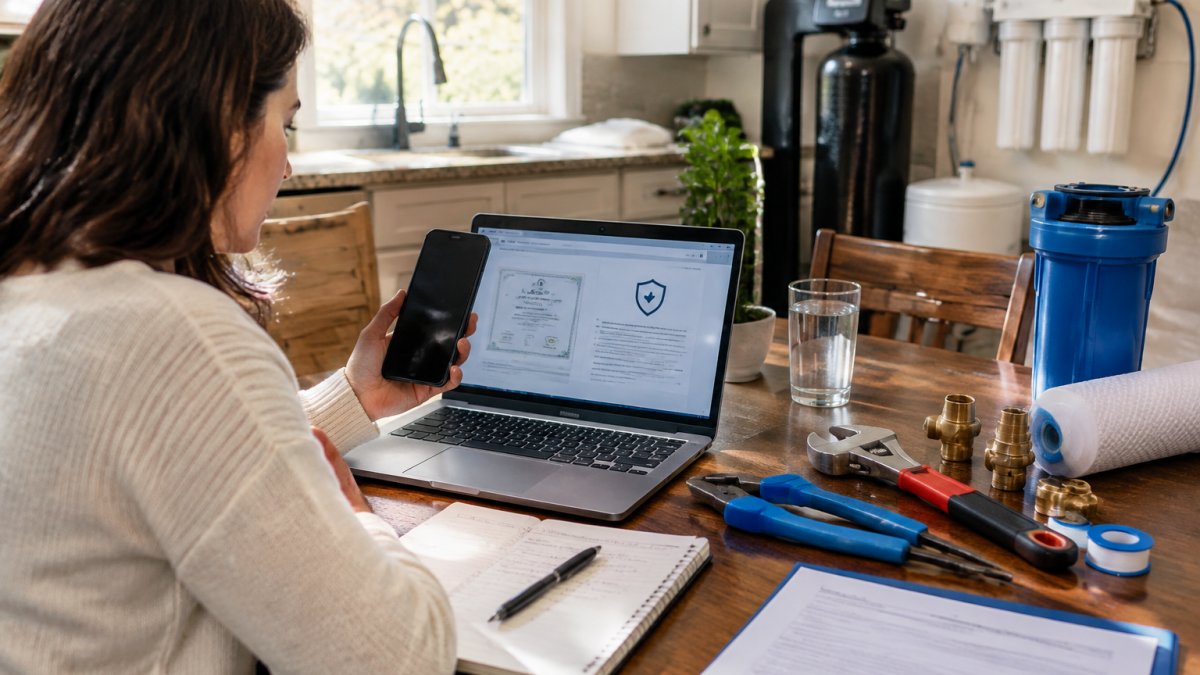
If you want a fuller walkthrough of what to ask and how to verify credentials, our guide on finding a licensed plumber for water system installation covers permits and timelines in detail.
Watch out: A plumber who dodges the license question, promises to "send paperwork later," or cannot name the licensing board is telling you something. Unlicensed work can create problems with insurance and with selling the house later.
Questions to Ask Before Hiring a Plumber
The right questions to ask before hiring a plumber fall into four groups: credentials, scope, cost, and follow-up. Ask them on the phone before anyone comes out, and you will filter out most of the wrong candidates in ten minutes.
Start with credentials. "Are you licensed and insured, and can you send proof?" Then move to scope. "Have you done this exact job before, and can you describe how you'll approach it?"
Then get to money and follow-up:
- Cost: "Is the service call fee separate from the repair cost, and will I get a written estimate before work starts?"
- Permits: "Does this job need a permit, and will you pull it?"
- Warranty: "What's covered after the work is done, and for how long?"
- Timeline: "When can you start, and how long will it take?"
- Cleanup: "Who handles cleanup and disposal?"
Ask about the warranty in plain terms. A one-year parts-and-labor warranty on an installation is a real commitment. "We stand behind our work" is not.
One more question most people forget: "Who will actually be at my house?" Some companies send a salesperson first and a subcontractor later. You want to know who is doing the work.
How to Compare Plumbing Estimates Line by Line
Comparing plumbing estimates means reading past the bottom-line number and matching each line item to the work you asked for. For water treatment, the gap between quotes is usually in the equipment model, the sizing calculation, and what happens after the install, not in the hourly rate.
Put every estimate side by side and check these items:
| What to Check | What Good Looks Like | Warning Sign |
|---|---|---|
| Scope of work | Lists each task and material, including model numbers | Vague "labor and parts" |
| Equipment | Names the softener, filter, or RO model and its capacity | "A softener" with no brand or size |
| Sizing basis | Shows a water test result and grain or flow calculation | No test, no numbers |
| Line items | Separates labor, parts, permits, and haul-away | One lump sum |
| Exclusions | States what is not included, such as electrical or drain work | Silence on hidden work |
| Payment terms | Deposit and balance schedule tied to milestones | Full payment up front |
| Warranty | States parts, labor, and duration separately | "We stand behind our work" |
Ask each plumber to explain any line you do not understand. A confident pro will walk you through it without irritation.
A few estimate details deserve their own question. Ask whether the diagnostic or service-call fee is credited toward the repair if you approve the work. Ask whether the quoted price is flat-rate or time-and-materials. Ask what the warranty covers over time, and who honors it, the installer or the manufacturer.
For a side-by-side look at how service models and estimates differ between companies, our plumbing comparison guide breaks down what to weigh before you choose.
Watch out: An estimate that quotes a price before anyone has tested your water is worth questioning. Hardness, iron, and sulfur each change the equipment needed, so a firm number without a water test deserves a closer look.
Red Flags That Signal an Unreliable Plumber
Warning signs show up early if you know what to look for. The clearest red flags are pressure to decide on the spot, cash-only demands, no written estimate, and a truck with no company name or license number on it.
Here is what should make you walk away:
- High-pressure upsells. A plumber who finds three unrelated problems in ten minutes is selling, not fixing.
- Big deposit demands. A reasonable deposit is normal. Full payment before work starts is not.
- No physical address. A real local business has a shop or a registered address you can check.
- Refusal to put it in writing. Verbal promises vanish when something goes wrong.
- No permit for permitted work. Skipping permits can cost you at resale.
If a provider feels off, trust that feeling. Our guide to vetting licensed local plumbing options covers what to ask before you hire and how to spot unreliable providers.
How to Choose a Water Filtration System Installer
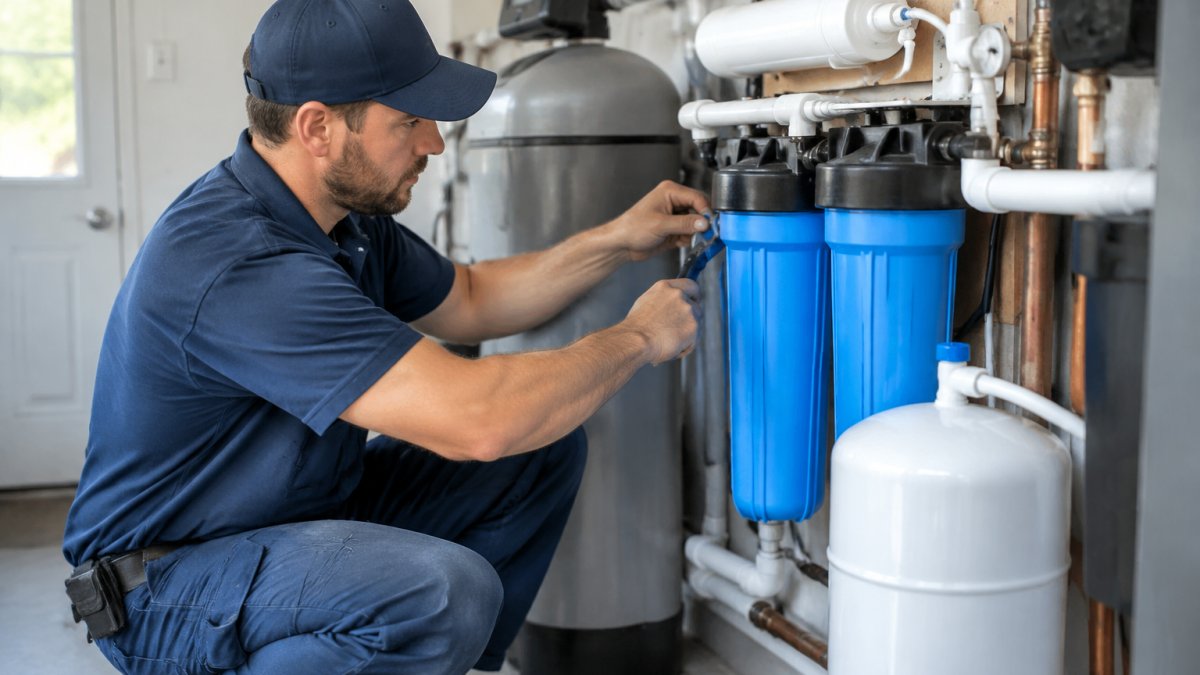
Choosing a water filtration system installer comes down to three things: plumbing credentials, water testing, and a system matched to your actual water. A general plumber can install a filter. An installer who tests your water first will size the system correctly.
Hard water, iron, and sulfur each need different treatment. A whole-home softener handles hardness. Iron removal needs its own stage. Reverse osmosis polishes drinking water at the tap. Installing the wrong setup wastes money and leaves the problem in place.
Ask any installer these questions:
- Do you test my water before recommending a system?
- Are your installers licensed plumbers?
- What happens if the system does not fix the problem?
- What maintenance does it need, and how often?
AquaShield Home Systems is family-owned, with licensed installers and over five years of local experience. We offer a no-pressure assessment. If you are ready to move, you can book water filtration services with a licensed team.
Get a Free Estimate From a Licensed Local Plumber
The final step is simple: get a written estimate from a licensed plumber and compare it against what you learned here. Check the license, confirm the insurance, read the line items, and ask about the warranty before you sign.
AquaShield Home Systems offers transparent pricing and a no-pressure assessment. Our licensed local plumbers handle whole-home softeners, reverse osmosis systems, and iron removal. You can request plumbing services and a free estimate and get a straight answer on what your home needs.
Frequently Asked Questions
What is the best way to find a good plumber?
Start with recommendations from neighbors and local family and friends, then cross-check those names against Google reviews and your state's licensing database. A good plumber has an active license, carries liability insurance, and can provide a written estimate before work begins. Ask about their service area and response time, and request references from jobs similar to yours. Combining word of mouth with independent verification gives you the clearest picture of a plumbing company's reputation.
How do I know if a plumber is licensed and insured?
Ask for the license number and verify it directly through your state's professional licensing board website, which lists active status and any disciplinary actions. For insurance, request a certificate of insurance showing general liability coverage and confirm the policy is current. A reputable plumber will provide these without hesitation. If a contractor cannot produce a license number or proof of insurance, walk away. This step protects you from liability if something goes wrong during plumbing repair or installation work.
What should a plumbing estimate include?
A written estimate should list the scope of work, materials with brand and model numbers, labor hours, permit costs if applicable, and the total price. It should also state whether the quote is fixed or hourly, what happens if unexpected issues arise, and the warranty terms on parts and workmanship. Compare estimates line by line rather than by total alone, since a low headline number can hide fees for disposal, after-hours service, or permit pulls that appear later on the invoice.
How do I choose a plumber for a water filtration system?
Look for a plumber with specific experience installing whole-home water softeners, reverse osmosis systems, and iron removal equipment, not just general plumbing repair. Ask how they test your water first, since treatment recommendations should follow from actual water quality results. Confirm they handle permits and can explain warranty coverage on both the equipment and the installation.
Finding a plumber you trust should not feel like a gamble. Check credentials, read the reviews carefully, and insist on written estimates. When you are ready for a team that tests your water and explains the options, get started with AquaShield Home Systems and get clean, great-tasting water without the guesswork.