 listicle
Professional Well Water Testing Services: A 2026 Guide
Table of Contents
- What Professional Well Water Testing Services Include
- Well Water Testing for Bacteria and Coliform Safety
- How Often Should You Test Your Well Water: Testing Frequency Guidelines
- Interpreting Your Well Water Test Results and Next Steps
- DIY Well Water Test Kits vs. Professional Laboratory Testing
- How to Collect and Submit a Water Sample Correctly
- Finding and Scheduling a Local Water Testing Provider
- Frequently Asked Questions
Last Updated: October 20, 2026
What Professional Well Water Testing Services Include
Professional well water testing services provide comprehensive analysis of your drinking water through certified laboratory examination.
A complete professional well water testing service examines contaminants that DIY kits miss.
Certified laboratories use EPA-approved methods and accreditation standards that ensure accuracy, so you get a detailed report showing exactly what's in your water and what treatment options exist.
Many homeowners discover their water issues are more complex than assumed. A rotten egg smell might indicate hydrogen sulfide, bacterial growth, or mineral deposits, professional testing separates these possibilities.
Well Water Testing for Bacteria and Coliform Safety
Bacterial contamination is one of the most serious well water safety concerns.
Coliform bacteria occur naturally in soil and surface water. Their presence in your well suggests contamination pathways, cracks in the casing, improper sealing, or surface water infiltration, and signals compromised well integrity.
E. coli testing is more specific and more urgent. E. coli indicates fecal contamination, which means disease-causing pathogens could be present.
Professional well water testing services include these bacterial tests as standard components because they're non-negotiable for health safety.
How Often Should You Test Your Well Water: Testing Frequency Guidelines
Testing frequency depends on your water quality history, local geology, and whether you've changed your well system.
If your initial tests come back clean, continue annual testing to catch problems early.
Event-based testing matters too. After well repairs, pump replacement, or system maintenance, testing confirms the work didn't introduce new contamination.
Seasonal testing makes sense in Northern Colorado because groundwater chemistry changes with precipitation and temperature. Spring snowmelt alters mineral concentrations and bacterial activity, and summer drought can concentrate contaminants.
Interpreting Your Well Water Test Results and Next Steps
A laboratory report is only useful if you can read it. Most well owners receive a multi-page document full of concentrations, method codes, and benchmark columns, and the most common question is: is this number a problem? The answer depends on three things, the unit, the benchmark, and the method's detection limit.
Start with the units
Well water results usually appear in one of four units. Milligrams per liter (mg/L) and micrograms per liter (µg/L) are most common for chemicals, where 1 mg/L equals 1 part per million (ppm) and 1 µg/L equals 1 part per billion (ppb). Bacterial results are reported as colony-forming units per 100 milliliters (CFU/100 mL), or present or absent. Hardness is often reported in mg/L as calcium carbonate, which converts to grains per gallon by dividing by roughly 17.1. A result of 5 means something very different in mg/L than in µg/L.
Understand the benchmark column
The report compares each result to a health-based or aesthetic benchmark. The U.S. Environmental Protection Agency (EPA) publishes two relevant categories. A Maximum Contaminant Level (MCL) is an enforceable limit for public water systems, and many states apply similar benchmarks to private wells. A Secondary Maximum Contaminant Level (SMCL) is a non-enforceable aesthetic benchmark for iron, manganese, sulfate, and total dissolved solids that affect taste, odor, staining, or scale rather than health. Read the benchmark column before the result column.
Read the detection limit, not just the result
Every method has a detection limit, the lowest concentration the laboratory can reliably measure. A result reported as "not detected" or "< 0.5 µg/L" doesn't mean zero; it means below that method's limit. This matters for arsenic, where the federal MCL is 10 µg/L and labs typically report down to 1 µg/L or lower. If a report shows "not detected" at a limit of 5 µg/L, the water could still contain arsenic at half the MCL. Ask the lab what its reporting limits are for the contaminants you care about.
A plain-language decision framework
With units, benchmarks, and limits in hand, sort each result into one of three buckets.
- Within benchmark and no aesthetic issue. No action beyond your normal testing schedule.
- Within a health benchmark but above an aesthetic benchmark. The water is not a health concern for that contaminant, but it may stain fixtures, taste off, or scale appliances. Treatment is a comfort and equipment-protection decision, not an emergency.
- Above a health-based benchmark. This is the bucket that requires prompt action. Stop using the water for drinking and cooking until you have consulted your state or local health authority and a qualified treatment professional, and retest after any treatment is installed to confirm it is working.
Match the result to the right treatment category
The report often includes recommendations, but it helps to understand the logic. Elevated hardness points to a water softener. Iron and manganese above aesthetic benchmarks point to an iron removal filter, often paired with a softener. Sulfur odor points to aeration or oxidation followed by filtration. Nitrate above the MCL isn't removed by softening or standard carbon filtration and typically requires reverse osmosis or an alternative water source. Arsenic requires a specific adsorptive media or reverse osmosis depending on the form.
What to do next
If every result is within benchmark, keep your testing schedule and file the report. If results are elevated, retest to confirm before investing in equipment, then choose treatment based on the contaminant, not a generic package. After installation, retest to verify performance, and keep every report, a documented history is valuable when you sell the home or file an insurance claim. If a result is confusing, call the lab and ask them to explain the unit, benchmark, and detection limit for that line item.
DIY Well Water Test Kits vs. Professional Laboratory Testing
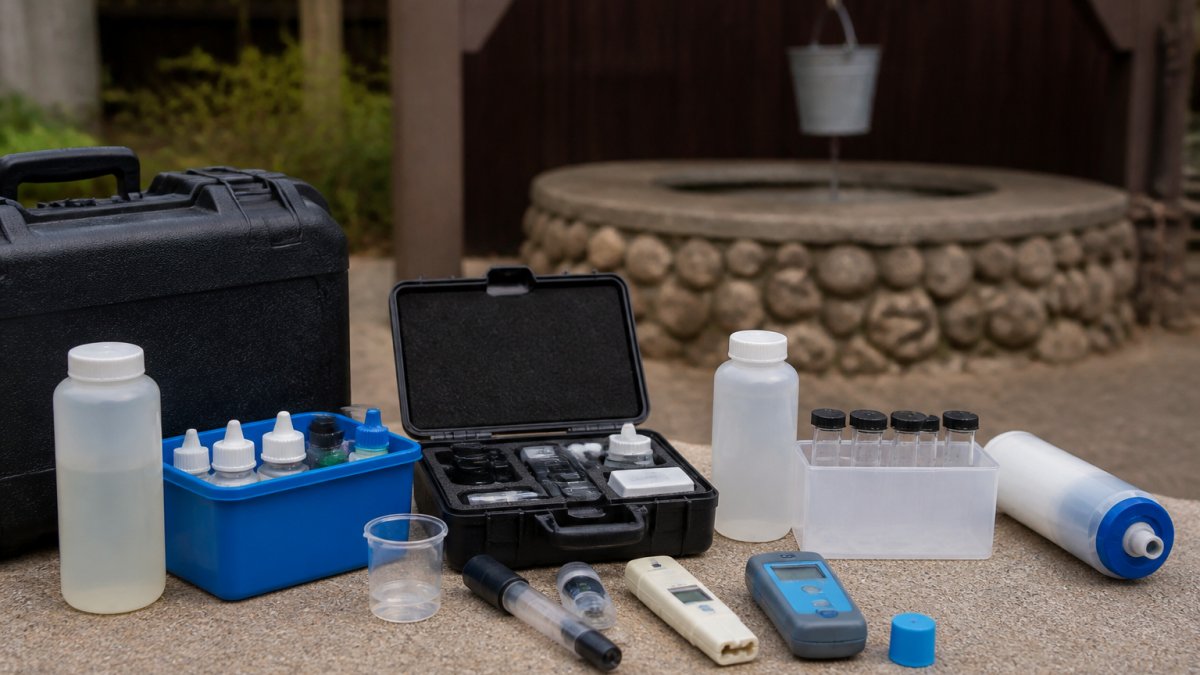
DIY water test kits at hardware stores cost significantly less than professional testing and offer immediate results without waiting for laboratory analysis.
The tradeoff is accuracy and scope.
Professional laboratory testing uses sophisticated equipment and standardized protocols.
Professional testing also creates a defensible record. Buyers want to see professional results when you sell, and insurance companies and health departments recognize certified laboratory results.
The best approach combines both methods. Use DIY kits for routine monitoring between professional tests.
How to Collect and Submit a Water Sample Correctly
Sample collection procedures directly affect accuracy. Improper technique introduces or removes contaminants, producing results that don't reflect your actual water quality.
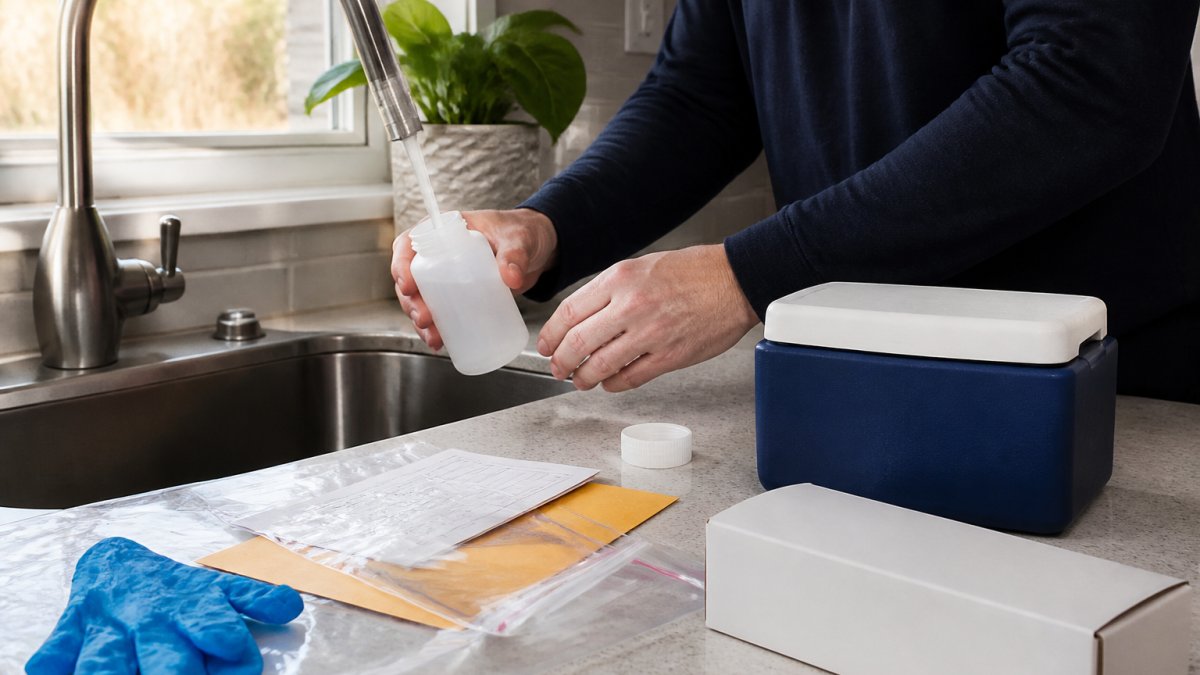
Professional well water testing services provide sterile collection bottles and detailed instructions.
Collect samples in the sterile container provided, never one you've cleaned yourself, residue from dish soap or previous contents contaminates results.
Label the sample clearly with date, time, and location.
Transport samples promptly, most bacteria tests require delivery within 24 hours. Keep samples cool but don't freeze them; many labs provide coolers or shipping instructions.
Finding and Scheduling a Local Water Testing Provider
Finding a qualified provider is less about the name on the truck and more about the credentials behind the laboratory running the analysis. Compare providers on substance rather than marketing.
Verify the laboratory, not just the company
Ask which laboratory performs the analysis and confirm its credentials. Two benchmarks matter: state certification (most states certify labs for drinking water analysis, and your state health or environmental agency publishes a list) and accreditation to ISO/IEC 17025, the international standard for testing and calibration labs. A provider that won't name its lab and certification is a yellow flag.
Ask what is actually in the panel
A "standard well water panel" isn't standardized across providers. Ask for the analyte list in writing and compare. A useful baseline panel for a private well typically covers total coliform and E. coli, nitrate, pH, hardness, iron, manganese, sulfate, chloride, total dissolved solids, and conductivity. Confirm whether arsenic, lead, and fluoride are included or available as add-ons, and whether the lab can test for volatile organic compounds (VOCs), pesticides, and PFAS if warranted. A provider testing only bacteria and hardness is offering a screening, not a full picture.
Match the test to your situation
Different situations call for different scopes. A new well or home purchase warrants a comprehensive panel including bacteria, nitrate, arsenic, lead, and common aesthetic parameters. A routine annual check can be smaller. A water-quality complaint (staining, odor, taste, corrosion) calls for targeted testing of the likely culprit plus a baseline. Near agricultural land, a gas station, a landfill, or a former industrial site, ask about contaminants associated with that land use, your state or local health department can tell you which are of local concern.
Compare turnaround, sampling support, and follow-up
Ask how long results take and whether the provider supplies sterile bottles, chain-of-custody forms, and clear sampling instructions. Ask whether results come with interpretation and treatment guidance or just a PDF of numbers, and whether the provider will retest after treatment installation. These details separate a lab drop-off from a full-service provider.
Schedule around the problem, not the calendar
Time your test to the condition you're trying to understand. If staining or odor appears in summer, sample in summer. If you're concerned about spring snowmelt or heavy rain infiltration, sample after the event. For a routine baseline, pick a consistent month each year so results are comparable. After any well repair, pump replacement, or nearby land-use change, schedule a retest rather than waiting for the annual cycle.
A simple comparison checklist
- Laboratory name, state certification, and ISO/IEC 17025 status confirmed.
- Written analyte list for the panel, with add-ons and their scope.
- Sampling supplies and chain-of-custody provided.
- Turnaround time stated in days.
- Interpretation and treatment guidance included.
- Retest-after-treatment option available.
- Scheduling aligned with the season or event you are investigating.
AquaShield Home Systems provides professional well water testing services alongside water treatment solutions, including water softeners, whole-home filtration, and reverse osmosis systems. Our team helps you choose the right panel, explains results in plain language, and recommends treatment only where the test supports it.
Frequently Asked Questions
What should I test my well water for?
At minimum, test for total coliform bacteria and E. coli, which indicate fecal contamination. The EPA also recommends testing for nitrates, which can leach from septic systems and agricultural sources. Beyond these, testing depends on your local water quality concerns, iron, sulfur, hardness, pH, and turbidity are common in many regions. A professional water quality assessment identifies which contaminants are most likely in your area and recommends a targeted test panel.
How often should I test my well water?
Test at least once yearly for bacteria and nitrates. Test more frequently, every 3 to 6 months, if you've had positive results for contamination, recently had repairs to your well or plumbing, experienced flooding near your well, or notice changes in water taste, color, or odor. Event-based testing is also important: test after heavy rainfall, if family members become ill with gastrointestinal symptoms, or if neighbors report water quality issues.
What's the difference between a DIY well water test kit and professional laboratory testing?
DIY kits are affordable and quick but often less accurate and limited in scope. Professional laboratory testing uses certified equipment, trained technicians, and standardized methods that meet EPA and state drinking-water standards. Labs can test for a broader range of contaminants, provide detailed reports, and deliver results you can trust for health decisions. For well water, professional testing is strongly recommended because bacteria and chemical contaminants can pose serious health risks if missed.
How do I know if my well water test results are safe?
Compare your results to EPA drinking-water standards and your state's well-water guidelines. Total coliform bacteria and E. coli should be absent. Nitrates should be below 10 mg/L. pH should typically fall between 6.5 and 8.5. Your test report should include recommended actions for any contaminants found. If results show unsafe levels, a qualified water treatment professional can recommend a filtration or treatment system tailored to your specific contaminants.